Tampilkan postingan dengan label Communication. Tampilkan semua postingan

Minggu, 30 September 2012

Generations Across: Why Stop Love Ageism

As a wife with a husband 10 years my elder, I definitely hear this article--if from the hetero perspective. Even from the hetero perspective, there's already ageism. Well, I couldn't fall in love with that person because of their age. Our sexual and love choices include many factors, including age.

But what about gay couples where one partner is older? How do both hetero couples respond to that and how can the gay community be more accepting? How can we all be more accepting to couples that might be different to our own dynamics? JacoPhillip Crous reports.

* * *

“The sex is more imaginative; 
 it feels more sensitive
 and this allows us to make love 
 with a greater degree of altruism.”

– James*, 32, 
 partner of twelve years to Mark*, 54.

Seen here, Juan Hidalgo’s photograph of two men kissing made a very controversial impression early in 2012. I was discussing it with a colleague when he brought to my attention the age difference between the two men in the photograph.

Suddenly many conversations rushed into my mind. I hurriedly had to nip our deliberation in the bud and proceeded to rifle through the narratives of couples who have crossed the generation divide, sharing with me so many of their experiences, viewpoints, and insights.

What is Ageism?

Ageism is prejudice and/or discrimination on the grounds of a person’s age. In gay communities around the world, ageism is more than problematic.

It constrains mens' masculine development, is caustic to our shared identity in manhood, and more importantly, consumptive of our sense of gay community. Some gay couples' love and lust for one another bridge across their generation gap. Those couples have a very good vantage point to observe gay mens' prejudices and gay social discrimination around aging and generation cohorts.

Let's not be ageist with love

William*, as a young gay man of 24, now partner of five years to John* who caricatures himself “a mature child of 40”, recalls how, while he was still just dating John, gay friends would repeatedly refer to him as “the young boy”. William was once very upset at one of John’s peer friends referring to him as “some fresh young thing”. I remember John commenting while the two of them scooched closer together on the couch: “As if Will was going to go off by a certain date.” It may just be the way gay men talk, but a stereotype is at its best offensive, and even more so when we consider that in circumstances such as these it comes from those who are opposed to themselves being stereotyped in any way.

James, 32, and Mark, 54, have been committed to each other for more than twelve years, yet whenever they step out of their circle, the age gap in their relationship opens a Pandora’s box of prejudices. James once remarked that, “the majority of older gay men we meet, treat me as some vapid nymph only after an easy ride (no pun intended), while Mark receives patronizing, congratulatory pats on the back as if he has won me as first prize in a pissing contest . . . younger guys usually react with waves of incredulity and panic.” It saddens me to have to agree with Mark when he says that the majority of young gay men are not interested in what older gay generations have to contribute.

It is the older generations that fought, sweat, tears, and blood for the acceptance and rights many younger generations now take for granted. “My generation made a gay reality possible,” points out Paul, 62, now in the sixth year of partnership with Peter, 38. Everyone over forty now has lived before and during the AIDS epidemic. Older generations were, in that context, also the pioneers of safe sex. “Safe sex, in some ways, made us look for other sexual practices” says Paul, Peter following quick with, “I learned that from Paul . . . there is so much more we can do than just fuck.” Paul takes heart that there are still some young men who value the traditions that provided a community in the first place, that “there are still young men out there who appreciate our minds and our sex.”

The couples I have had the pleasure of knowing, as diverse as you can imagine, strike accord on one very pertinent characteristic. Sex is experienced by both partners to be more imaginative. It is felt to be more sensitive and given with a greater degree of altruism. I believe that this is a result of mentorship these sexual partners share and enjoy. It's driven by the emotional satisfaction we all gain from teaching our beloved and being taught by our lovers.

Let's consider the historical context

The tradition of mentors in homosocial communities reaches far back into ancient Hellenic and Roman cultures, and likely beyond. It shouldn’t be a surprise that this dynamic raises its head, so to speak, in contemporary homosexual culture.

Because many gay men leave home without having been taught the finer things, like which linen to buy, which crystal to have, how to arrange flowers, choose a colour scheme, or how to throw a dinner party, these things and more are considered community things to be learnt from gay communion.

As homosexuals, we have to recognise that there are traditions that hold our global gay community together. This recognition on the side of the elder is perhaps the one thing that most separates the generations in gay living today. This sense of mentorship in gay culture is most pronounced in couples were there is a pronounced age difference between partners.

Let's nurture all loving, consensual relationships

Nurturing a relationship across such a generational gap is no matter of course though. The double prejudice suffered by these gay couples is a near active dissuasion. Not only do these men have to overcome the hegemonic disdain for their commitment and relationships. They also face prejudgement from within the gay community over their partnerships. Aron, 45, has been in a relationship with Tom, 27, for little over two years now and says to me, “I see it, our relationship... as a mirror image of the same condescension suffered by interracial couples.” Now, before your mind opens a whole other can of worms, this statement sharply focuses the feeling of discrimination these gay couples experience.

We should not perpetuate terms of endearment. Our love for our partners, if not revered, should at least be respected. Union in partnership, our emotional commitment, our sense of gay community, is in the fact that we love and choose to partner with someone of the same sex. As valid and enriching as these exemplary relationships are to the men in them, so too they are to gay community.

GetLusty provides recognition and support to all couples. If you would like to know more on a specific topic or have a particular question in need of an answer, GetLusty resources are enriching the lives of people in committed relationships around the world and you are welcome to subscribe. Have your comments and queries tackled by the professional talent (like me!) contributing to GetLusty.

I will share more gay coupling experiences with you next week on Get Lusty. Coupling: Trust clouts Fear, will include my personal experiences when I engaged with the coupling guidance process together with my ‘husband’ of over eight years.

Get the lust on for your lover, and share the joy and learning from it with the lovers of the world.

Do It well; do It safe.
 Jacsman
*For ethical privacy all person names are given as nom de guerre

Though he's a new writer, we're already extremely excited about JacoPhillip. Our resident advisor on gay long-term relationships, JacoPhillip Crous is also known as Jacsman.

He studies & consults on ecstatic & intimate psycho-sexual health & development, promoting & improving male2male dialogue that furthers understanding of masculine sexuality and MSM relationships. A sex educator, JacoPhillip Crous studies about and consults around male psycho-sexual self-development phenomena, behaviours, experiences and knowledgeablity. Find out more about JacoPhillip at: http://about.me/Jacsman. Also subscribe on Facebook.

Jumat, 28 September 2012

Why We Love Freud


We often think about sex. Why? Sex is one of those instinctual urges. This is an idea Sigmund Freud talked about frequently. Shannon Ray is here to talk about why Freudian ideas and Freud himself influences sex today.

* * *

Sex through history

Throughout history, sex has played a major role. Wars have been started due to it; think Helen of Troy. Clothing has been designed to hide it; think Victorian era or to enhance it; think rubber, leather and latex. The type of beer and automobile we purchase are due to hidden sexual messages in advertisements. Even the expression "getting laid" dates back to the customers of a 1900’s Chicago bordello the "Everleigh Club". ("I’m going to get Everleighed tonight.") Some feel that our very existence comes down to simply getting laid, that sex is the primary motivation for our existence.

Freud's sexual theories

Sigmund Freud was one of those people. His belief was that everything we do is in relation to sex. Case in point: Being a pet owner shows the "softer" side of one's persona: a caretaker, a giver. We earn a paycheck to show that we are stable and able to provide. We shower and brush our teeth, and practice good general hygiene to attract others to us.

Even though there are some of us who choose not to mate, we are inherently sexual creatures. In the end, it’s all smoke and mirrors to attract someone into our “sexual web." Sex is wired into our brains- whether we like it our not.

In situations, difficult or not, we get defensive about those three little letters: S E X. No matter your social class, income level, gender role or credit history- sex is a part of our lives. Either we are not getting enough or we are getting too much. It’s either too kinky or too vanilla for our taste buds. Our partners are either too fast on the draw or too slow for words. Sex rarely seems to be just right. But when it is, it’s the equal to a starvation diet that ends with a buffet. It’s the best we ever had and we’re not too proud to beg for more. And though you may not agree with Freud or me we both have a point:

In the end, is sex the reason? Give it a moment and think about it.

Thinking about primping

How vigilant would we be in our primping ritual if sex weren’t the wanted result in the end? Would a Stairmaster really be a high priority if no one were there to watch our asses? That last piece of pizza or cheese Danish would be finished off with a smile instead of a dismal sigh while calculating calories. And even when we do get the prize, is it really worth it? Wouldn’t all this be much easier if we purchased a vibrator and lived like we wanted to?

Let’s take for example a typical relationship (which in the end is really just code for wanting sex on a regular basis):

You meet and are freshly groomed from your non-showing roots atop your head to your freshly painted toenails. You’re on your best behavior; all the time your hormones are in overdrive. The courting process has officially begun. This means that you must wear only your sexiest underwear, shave and moisturize your legs, and carry extra breath mints in the purse that you never used to carry. (Because, as everyone knows, you need to look both sexy and organized when trying to get laid.) You’re beyond witty, beyond charming, beyond anything you’ve ever been. This is no ordinary persona, this is “super you”. This is your “gonna get me some” self.

Finally the big night arrives. You’ve polished, waxed, shaved, trimmed, and tweezed as much as possible. There are enough candles to light a small village. Hours have been spent cleaning the entire house- just in case there’s a pre-sex inspection.

Soon the fresh sheets are no more. The sex monster has beckoned and you have answered the call. All the time, wishing you had checked your caller ID prior to answering. Soon enough, you’ll be wearing your faded flowered underwear instead of the black thong. Your roots will be showing, proving that you’re really not that true blonde, brunette or redhead. Some dismiss this as the “groove” of a relationship. But let’s face some facts. The let down has happened, the sexual conquest is over and it wasn’t much to write home about. And all that’s left are some melted candles and stale breath mints.

Before long, we’ll be primping ourselves and be back on the prowl. And none the wiser for we never really learned our lessons. If we luck out tonight, it’s back to scrubbed walls and organizational clutches. If not, I suggest investing in a vibrator and a brownie or two.

Shannon Ray has been interested and active around sex blogging for years. She loves talking, thinking about and researching sex. So, of course, she's the perfect GetLusty writer!

“I was raised by a tribe of drag queens. They taught me how to be fierce with a pen and lip-gloss,” often jokes writer Shannon Andrews-Ray. Having dated both sexes for nearly 15 years, Shannon gives an ‘Alice through the Looking Glass’ spin on the often hilarious mating habits of both men and women, through her various incarnations of her dating columns. “Love’s Frosting” is her most recent tumble. Want to get in touch? E-mail her here.

Kamis, 27 September 2012

"Mindfulness" as Sex Therapy

 Being mindful of your sexuality and even your emotions benefits your personal development. Meditation is healing. Sex is also healing. So, why wouldn't they both help sexual trauma or difficulties? How about channeling that mindfulness into your sexuality? GetLusty advocate, sexologist and sex therapist, Dr. Jenn reports.

* * *

Boring sex? Pain during intercourse? Distracted in bed? Sex addiction? No desire to get it on? Is it possible that all these sexual concerns and sex problems could have the same remedy? Yes, and that remedy is the ancient Buddhist practice of mindfulness.

Mindfulness is an awareness skill of being present in the moment, with your thoughts, emotions, and sensations. It is noticing the present moment and – here’s the kicker – not judging what you notice. The health benefits of mindfulness are profound: stress reduction, decline in anxiety, depression relapse prevention, overcoming addiction, and reducing chronic pain, not to mention greater happiness and fulfillment in life.

Researchers are also delving into the sexual realm to see how mindfulness can improve sex lives. Although little research has been done so far, it seems to be beneficial for women with low desire, vulva pain, and emotional distress from past sexual trauma. There is anecdotal evidence that it is valuable for sex “addiction,” erectile dysfunctions, and boredom.

I’ve been integrating mindfulness-based practices into my sex therapy and couples counseling work for several years because I think it’s the foundation for all personal growth.

Do you freak out with jealousy if your boyfriend receives a text from another woman? Mindfulness can help break that automatic pattern. Are you distracted during sex by your bulging belly or your long to-do list? Mindfulness skills keep you grounded in the moment and release such mind chatter. Integrating little daily practices of mindfulness can make these big brain changes.

I have mindfulness on my brain more than usual this week, because I just went to a sex conference this weekend. Its not as sexually titillating as it may sound, but it will be intellectually titillating. At this 2012 annual conference for AASECT (American Association of Sexuality Educators, Counselors, & Therapists) in Austin, TX, I will be speaking on “Get Out of Your Head & Into Your Body: Improving Sex Lives Through Mindfulness.” My take home message for the audience? Mindfulness is the new sexy.

This was originally posted as part of Pacific San Diego Magazine's sex & love blog series. Check it out the Mindfullness post here.

Jennifer Gunsaullus, PhD, is a sociologist, sexuality speaker, and sex therapist, with a passion for challenging people to sexually think outside the box.

Dr. Jenn is a public speaker on topics including healthy relationships, love, gender, mindfulness, erotic play, and happiness. She counsels individuals and couples, in person and over Skype, to assist in creating and maintaining open communication and fulfilling intimacy. Dr. Jenn is a contributing writer for Pacific San Diego Magazine and is a sex and relationship expert on Fox 5 news and San Diego Living. Follow her on Twitter @DrJennsDen and Facebook.

3 Reasons Premarital Sex is Absolutely Essential

premarital sex married image
GetLusty is all about having better sex and making stronger relationships. Why don't we just talk about married couples? Because not all couples in long-term relationships are married, and that's OK. For us, marriage is both by the heart and by the law. So you might be in a loving homosexual relationship and marriage isn't even an option. Either way, sex is a very important part of relationships. Our Crimson Love explains why.

***

Growing up, I am sure most of our parents told us not to have sex before marriage. It just wasn't what good boys and girls do. We were supposed to wait until we fell in love and found "the one". Sounds so romantic and sweet doesn't it? Well, let me just say that I am the child of divorced parents. My mother waited for marriage to have sex only to get divorced 36 years later because she was a lesbian. Needless to say, waiting until marriage thing became invalid very quickly.

Dirty clothes hamper photo Live together & learn about each other

In this day and age, with 1 in 2 marriages ending in divorce, it seems like you would want to test drive the care before you buy it! Before you marry someone, living together lets people understand their partners inside and out. Of course, this may make or break relationships. But it should! This means you weren't meant to be together in the first place.

Catch onto their bad habits like drinking out of the milk jug, leaving their dirty socks around, not washing dishes for days or otherwise. You don't want to be married for 2 years and then get divorced because you couldn't stand how messy someone was. Anyway, divorce likely wasn't because of their messiness, but a whole variety of reasons. Divorce happens for reasons like money or sex problems, for example.

sex in progress sign photoSex should be positive and normal

Secondly, sex is a very big part of any normal, healthy, adult relationship. Why should we be ashamed of having this loving act with an individual who we aren't technically, "married" to?

What is sex, anyway? It's meant as a means for two people to connect to each other and enjoy each other in the most organic of ways. Some even avoid certain kinds of sex before marriage because that ensures they're still, "pure". Think oral sex or anal sex. What? That's insane.

On the flip side, if your lover is bad in bed and you're never satisfied, the relationship is bound for failure. If you test drive that car before buying, you can avoid a bad a situation and heartbreak. While we don't think, necessarily, bad sex should end in divorce, that can happen.

Intimate sex pretty photoSex enhances intimacy

Lastly, sex and other erotic activities are good for intimacy. In an earlier article, I wrote about the importance of intimacy in relationships. It's a building block for strong relationships. You're being romantic with each other, enjoying the time together, exploring each other, and testing each others limits. These are all extremely important for healthy relationships.

Have fun and remember that sex in relationships is important. It can actually help you make a more informed decision about the person you decide to spend your future with. Have kids? Talk with them about sex in a positive way. Don't worry, we'll help. We'll be offering sex positive parenting advice very soon.

With love from GetLusty!

This is a guest post by our very own Crimson.

Crimson is our resident BDSM fetish expert. If you don't see Crimson out dining with her adoring boyfriend, you'll find her reading books on innovation or finance. Crimson is currently finishing off her Bachelor's, she is passionate about food, photography, music and especially sex--and she's not afraid to talk about it. With everyone!

Have story ideas? Get in touch with Crimson at amber@getlusty.com.


Ladies! Multiple Orgasms 101

It's no secret that GetLusty For Couples loves vulva's, the clitoris and the vagina. Gosh, we love all areas of our female bodies! So when we have the chance to publish an article on multiple orgasms. Well, we're tickled. Anne Brown, of the Enlightened Sexpot, is back with more orgasmic writing. What about? You guessed it, orgasms! In honor of Orgasm October which is just around the corner, she is here to discuss the mystery of multiple orgasms.

* * *

Some canny readers may have noticed that I alluded to the totally awesome ability for vagina-owners to experience multiple orgasms in my last post on clitoral orgasms.

If you said, “Oh yes, multiple orgasms, please!” when I mentioned an orgasm in which “you don’t want to short-change the zings,” guess what Holmes? You win. Why? Because it only dawned on me a week later that the phrase “multiple orgasms” even applied in that situation.

The ability to have multiple orgasms was kind of on a pedestal in my brain. I thought that being “multi-orgasmic” was some special trick that only the real experts could master. The problem with this–and anything sexual on a pedestal (see the Cosmo article Multiple O’s: Why One Orgasm is Never Enough)– is that “multiple orgasms” then are only special because they can’t belong to just anyone.

Fuck the pedestal, guys. Multiple orgasms, virginity, whatever, the things are special if you have made your own personal choice to decide that they are special for you. I’ve said this already: every sexual experience that gives an individual pleasure is legitimate. If you’re not having multiple orgasms, you’re not “missing out”. That said, if you’re interested in how they work and/or how your favorite vagina(s) can feel more than one orgasm in a session, keep reading!

For penises

Before we begin: penis-owners, I haven’t forgotten you. I just need to get my hands on this book and do a little other research before I can write anything more in-depth about the penis’s ability to have multiple orgasms, which involve learning to orgasm without ejaculating (they are actually already separate things– in many male bodies it’s normal to feel the orgasm begin before ejaculation starts).

When penises ejaculate with orgasm, there follows what is called a, "refractory period" in which they become not interested in sex. This refractory period varies in time from person to person and will change with age, libido, stress, etc. Vaginas might ejaculate sometimes, but they don’t have refractory periods. Some clits feel painful when touched right after orgasm, but this isn’t an actual physiological refractory period–it’s just a clitoris that is really sensitive at the time.

Even that painful clitoris is capable of being stimulated to orgasm (if done very carefully with permission). Just like with one orgasm, all pussies are completely physically capable of having multiples, it’s just a matter of whether or not that particular pussy has discovered the best way to do it yet.

Debunking Cosmo

That Cosmo article I linked to earlier is only disguising itself as helpful, and I hope you didn’t read it before reading this.

First of all, the title puts pressure on the reader to want and work towards multiple orgasms, even if there is vague do-what-feels-good language inside the article.

Second, multiple orgasms are only talked about in the context of heterosexual penis-in-vagina intercourse, and it asserts that oral sex before intercourse and/or lots and lots of penis-thrusting are the “most common” ways that vaginas have multiple orgasms. Talk about being scared of maybe girls getting pleasure not from their “man”.

It sets itself up with a faux-cutesy “sorry, dudes– girls totally have you beat because we can have multiple orgasms” attitude that the author may have thought was empowering. I don’t feel good when I make other people feel not as adequate and/or give erroneous information so, Cosmo go away. The only good information in this piece was the definition of two different types of multiple orgasms that vagina-owners can experience: sequential and serial.

Sequential and serial orgasms 

Sequential multiple orgasms are orgasms that are only seconds apart– they are, in fact, what I was talking about when I said do not stop doing whatever you are doing because of the zings, etc. As a reminder and to qualify: these types of orgasms, which feel like one extended zig-zag of wantwant-orgasm!-wantwant-orgasm! to infinity and beyond, happen when the person in question is really super-aroused and there has been lots and lots and lots of foreplay (“of her choice”, thanks Wikipedia!).

This could potentially happen with lots of penis-thrusting for the high-estimate 30% of female bodies who come from vaginal intercourse alone, but for the vast majority, extra-thrustular stimulation will be involved. Dr. Ruth’s Encyclopedia of Sex (informative, not always as inclusive/ sex-positive as I would like) cites a couple of big-name studies in which average women experienced up to 50 sequential orgasms using vibrators. Tongues and fingers are also great, duh.

Serial multiple orgasms happen a few minutes apart, and vagina-owners get to demonstrate their ability to rapidly move through the human sexual response cycle of excitement-plateau-orgasm-resolution. While sequential orgasms bounce between plateau (wantwant) and orgasm (!), the experience of serial multiple orgasms allows a longer period to pass–one to several minutes– between each orgasm, and the entire cycle repeats itself. Re-excitement through a continuation of foreplay activities before the resolution phase totally sets in, leads to another plateau and then an orgasm. It might be a different-feeling orgasm than the last one, but that still “counts” as a multiple, just like having goal-oriented “I-want-an-orgasm-of-this-type” sex still “counts” as “not being fully appreciative of your/your partner’s body."

Qualities of those who have multiple orgasms

The 50-orgasm women in the studies cited by Dr. Ruth all had one thing in common: what seemed to be a “healthy, uninhibited sexuality”.

If I extrapolate correctly, this means that they didn’t feel shame about what they wanted or were experiencing, that they felt they were in a safe place where they didn’t need to have their guard up. If they were alone my guess would be that they stayed focused on themselves, had positive thoughts about their pleasure, and saw the experience as an exploration, not an achievement.

Additionally, if they were with a partner, this partner was probably someone that had made them to feel safe; feel cared about; someone who believed that their pleasure was important and not something “extra” or something to get out of the way. Truly “uninhibited” sex isn’t crazy sex where everyone does everything (necessarily), but instead sex in which a person and their partner feel connected to and totally accepting of themselves and the other. This kind of sex can and does happen with both strangers and married people: it’s all about the individual attitudes involved.

Did you know that anyone can have an orgasm? Like really, really anyone? Like even people with paralysis or who have experienced genital mutilation can learn to have orgasms through non-genital stimulation? I don’t want to say that “anyone” can have multiple orgasms because I don’t have enough information, but with the knowledge that anyone can experience orgasm it seems like it’s possible. Bodies and brains are awesome. I’m so glad I have my very own one of each.

References:
  • Westheimer, Dr. Ruth (1994). ”Dr. Ruth’s encyclopedia of sex”. New York, Continuum.
  • Ryan, Christopher and Jethá, Calcida (2010). ”Sex at dawn: How we mate, why we stray, and what it means for modern relationships”. New York, Harper Collins
  • Go Ask Alice (Columbia advice column)
  • Healthcentral.com Multiple Orgasms
  • Human Sexual Response Cycle via Wikipedia
  • Refractory Period (sex) via Wikipedia
Check out the original post The Enlightened Sexpot.


Anne blogs from her base in Boston as The Enlightened Sexpot and works at the Center for Sexual Pleasure and Health in Pawtucket, RI.

Originally from Seattle, she studied Spanish and Latin American literature/film/art at Dartmouth College while also obtaining a teaching certificate in Kindergarten- 8th grade.

In addition to her interest in any and all things sex-related, Anne is a huge NPR nerd, book nerd, and an enthusiastic spin class participant. You can follow her on twitter @shinysex and also check out her blog, the Enlightened Sexpot.

Rabu, 26 September 2012

Add Spice & Variety to Your Sex Life

Have you ever wanted to add some more sassiness into your "vanilla" relationship? Do you want to add a little role play into the bedroom? Perhaps you have been inspired by our Fifty Shades of Grey September and think some BDSM could be fun.

But where do you start? How can you get your partner on board without pressuring them or making them feel uncomfortable? Jean-Luc Gothos is here to give you 3 ways on how to introduce some variety into your long term relationship.

* * *

So do you want to add something to your sexy time tool box but don’t know how to introduce the new idea to your partner? Well I’m here to help you with that introduction. I think the first thing we need to look at is, what is it you want to do and why do you want to explore this part of your sexuality. I think once you can answer those questions for yourself, you’ll be able to better answer your partner's questions.

So you’ve been interested in trying some light bondage and maybe some impact play. How do you go about introducing these new concepts to your partner? Well I’ve always found that information is best. So when I want to introduce a new concept to my partner, I will take the time to really gauge their response to this new activity. I want to add to the intimate time we have together. Is their response one of excitement, is it something more mild, or does your partner reply with a "not in a million years." If it’s the last one, it’s time to really talk about what issues they have with the activity and why is it something they might not want to do.

#1 Don't force, discuss

Now keep in mind you’re not trying to convince them to change their mind, you are simply discussing why they don’t want to explore this new part of your sexuality with you. Did they have a bad experience before, or do they just need more information. It could be that they just truly aren’t attracted to that kind of sexual activity. Also whispering it in their ear as there doing sexy naked things, is never a good idea. Whispering, “I want to fuck you in the ass.” may just kill the mood. It could put your partner into a different headspace altogether. So make sure you bring up anything new you want to do before any sexual activity.

#2 Communicate

The introduction of new sexual concepts and ideas can take a lot of communication between partners. You have to be able to trust your partner when trying new things.

The only way you can do that is if you have not only discussed your sexual activity but also everything else you have going on in your life. It wouldn’t be good to have your partner tied up and suddenly start talking about how they never do the dishes or how they looked at that sexy waitress at the restaurant last week. So communication will be an important part of introducing new concepts and ideas into your sex play.

#3 Knowledge

A lot of people will say no to something simply because they don’t know anything about it. Generally people aren’t real fans of change. So you have to make sure that you have all of the information available to them in order to really talk about the issues involved. This will show your partner that you care about their needs as much as your own. They aren’t going to want to do this new sexy thing if it looks as if they won’t get anything out of it. Sex can’t be selfish, it can’t be all about you, and it has to be a mutual exchange of pleasure. If you aren’t able to provide that then your partner won’t want to do the new sexy thing you want to try out.

I think the real core of introducing new stuff in the bedroom is that you need to be communicating your wants and needs to your partner. If you can’t talk honestly about sex and about your wants and needs, then I think you might want to reconsider why you’re with the person you're with. You will need to ask yourself why do you feel you can’t communicate openly and honestly with your partner.

Jean-Luc Gothos is our resident pansexual geek. He's the founder of Mindchaotica. He is also very active on Twitter, Facebook, G+, and Tumblr. He also writes for Life On The Swingset, Kink~E Magazine, and he reviews sex toys on EdenFantasys and writes for their sex positive online publication Sex Is Social.

Podcast! Dr. Jallen Rix on Honesty for Deeper Love

Dr. Jallen Rix survived a strict, religious upbringing and ex-gay ministry. He wrote a book about it, and came out of the experience a more complete, honest person.

He's very secure in his sexuality and teaches others about how to realize their own sexual interests. How can monogamous couples have a more fulfilling love life? We talked with him about honest, loving experiences.

What we talked about:
  • What brought Jallen here? 
  • Why is it so important to be honest with your partner sexually? 
  • Why did he write his wonderful book, "Ex-Gay No Way" and what's it all about, anyway?
  • OK, so he's gay & poly. My husband is bisexual, is yours? Dr. Jallen answers how to integrate fantasy into your healthy relationship.
  • How can couples interested in bi-sexuality but not in polyamory explore?
  • What are different kinds of monogamy & why do they matter? 
  • What's in the prospect for Dr. Jallen? What's next?
More about Jallen:

Speaker, author, and educator, Jallen Rix has come a long way to be a sex expert. Growing up as a Southern Baptist, he was taught that spirituality was heavenly but sexuality was from the devil. While obtaining a B.A. in creative arts and a minor in theology, he also went to great lengths attempting to change his sexuality from gay to straight in an ex-gay ministry- to no avail.

That experience set him on a journey of discovery that ultimately resulted in Jallen earning his Doctorate of Education in Sexology from The Institute for Advanced Study of Human Sexuality in San Francisco, where he is now Associate Professor.

He pens the popular advice column, Sex Ed in Bed. As a sexologist, Jallen creates an accepting and safe environment that provides support, humor and insight for a wide variety of people to raise their awareness for a more positive and healthier sexuality. Learn more about Jallen Rix by reading his book, "Ex-Gay No Way." Follow him on Twitter @gaysexpert and subscribe on Facebook.

Selasa, 25 September 2012

Clitoral Orgasm 101: a Mini-Guide

Orgasm October is coming. Oh my. I didn't even plan that. So, of course, we can't wait. I know--it's Fifty Shades of Grey September. But, duh, there are so many ecstatic orgasms in there, too.

This is part of what necessarily needs to be a multiple part exploration of the anatomy. Want to achieve different types of orgasms? Know your anatomy! This post by Anne Brown focuses on clitoral orgasms for vagina-owners and vagina-lovers. What arousal looks like, tips getting your or your partner’s pussy ready for clitoral stimulation, what clitoral orgasms might feel like to you/your partner and why. Anne Brown reports.

* * *

Our overarching rule: All vaginas are different. 

I’ve tried to be on the “safe” side when describing arousal and clitoral stimulation, so your vagina might like more or less pressure, mechanical stimulation or otherwise. Something else fun and special and that is totally normal. Having trouble having an orgasm is also very normal and under no circumstances should anyone ever say that “this will make someone come” because that would put terrible pressure on you/your partner and that is not what we want. We want you to become enlightened about pussies!

I don’t want to say that I’ve had a clitoris for my “whole life” because I am not about to talk about how sex organs develop in a fetus and I don’t want to get into the when-does-life-begin territory.

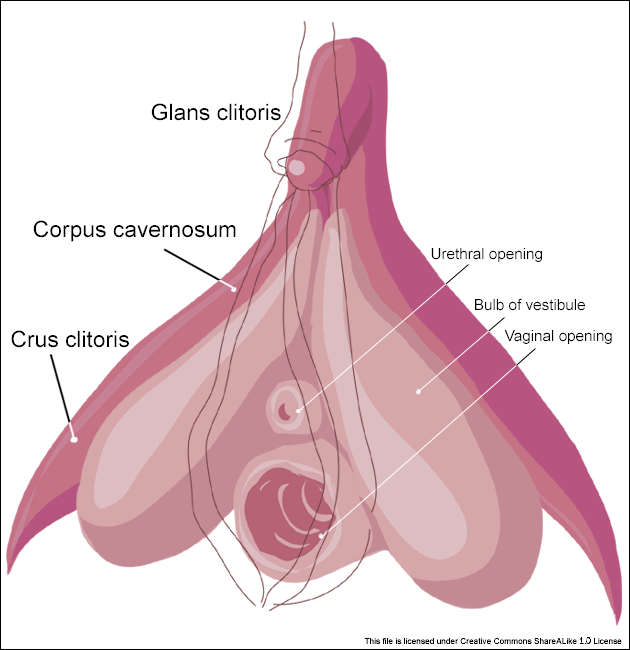
So instead: I am a clitoris-owner–have been for a long time–and I just learned that the clit isn’t just the little hard bulb that may or may not peek out when a woman is aroused. Actually, that little head is just the tip of this way bigger thing that goes underneath the inner labia! Look at this diagram– the dark pink parts are all clitoris-material!


Check out the anatomic map!

See the darker lines that trace down over the ‘glans clitoris’ and end together at the bottom? That’s the clitoral hood and the vaginal opening.

Doesn’t it kind of look like a flying penis?  Like a little penis with big wings flapping on a downward-flap like a drawing of a bird on those beach scenes you drew in 6th grade?

I was hoping you would notice because guess what: a penis develops in utero from the clitoris. Penises are sensitive all over the place but especially on the tip and guess what again: a clitoris is the same way. When a developing fetus becomes male, the outer labia on a vagina stick together to make a ball sack. That is why there is a seam on the scrotum if you’ve ever been in a position to notice that seam. Developing humans are pretty economical, guys!

Notice the nub

Just like the penises they sometimes engender, clitorises get erections when they want some sex. They might poke out and look like a little nub from under the hood, they might feel very firm to the touch underneath the hood, or they might stick out a long way. All three are normal.

Other physiological signs of vagina-arousal include blood-filled, pumped-up labia that have changed color (any color is a normal color!) and increased wetness. Wetness varies from person to person and from day to day, though, so while “this is definitely wet” is aroused, “not immediately apparent wet” isn’t necessarily a sign of not-aroused.

A quick note on dont's

If you are interested pleasing a chosen pussy, whether it be your own or someone else’s, do not–I REPEAT– do not stick anything straight on the tip of that clit unless you are very, very sure that this particular clit will like it. Checking for physical signs of arousal before touching the clitoris directly will help avoid any pain. If you are a good scientist and your “Is the pussy aroused enough for orgasm?” data seems incomplete, you can do some things to ensure that you are on the right track to helping the pussy experience a clitoral orgasm.

So many parts of the body that are not the clitoris feel nice to be touched and will arouse sexy feelings in the clitoris by proxy. Whether you are dealing with your own or someone else’s, good places to start are body-touches that could be near the zone of the clitoris. A thigh-or boob-squeeze, some nice petting and/or cuddling, some kissing.

Take your time

Even if you are in a partner-sex situation and sex has already been happening in other ways, the receiver of clitoris-pleasure needs to be relaxed/safe/happy-feeling, so take your time. When you’re ready to move to the vagina area of the body, start by petting or kissing the inner thighs and labia, and then use your tongue/fingers/vibrator/whatever and maybe try going between the inner and outer labia–closer to those legs of the clitoris!

And touch the vaginal opening. Another thing to avoid doing unless you know your chosen pussy likes it, is to just jab something into that vagina-opening. If you are going to do that, go slowly. If the vagina doesn’t seem that wet, wisely use some lube, making sure that it is not cold. You’ll want the clitoris to be wet when you touch it, anyway.  Check out all Vulva Lovely's wearable vulva jewelery on Flickr.

Moving onto the clit, start by feeling on top of the hood or on the sides for hardness. Press down. Listen to the noises your partner is making/ask so you know what feels good! If you are a pussy-owner stimulating yourself, think about whether something feels good for you or you just “think it should” and get rid of the “should's”. You can play with the clit with that skin on the hood/around it as a barrier if it’s is too sensitive to touch directly.

Don't forget to talk

Different pussies like different touching, so talk, listen and make noises and pay attention! Some people like a lot of pressure, or a little. Some people like fast vibration-feeling sensation and some prefer slow, more pulse-like movements. Every clit will like wet. On average it takes 20 minutes of clitoral stimulation to have a clitoral orgasm.

However, it’s definitely different for different people/times so don’t try to put a time limit on yourself/partner and don’t feel bad if it’s taking a long time. Since we’re just talking about clitoral orgasms, I’m not going into the fingers/penis/implement inside the pussy at all. Why? I don’t want any confusion with g-spot stimulation, which works for some and not others in varying degrees. Your chosen pussy might like something inside of it even if most of the action is on the clit and outside the body.

You can try a ton of things at the beginning, but once you find something that is really feeling good for your chosen pussy stick with it and keep doing the same thing. When climax is near, the clit does not want anything new! It wants that exact same thing that is making it feel so close to orgasm.

Orgasm time

Orgasm Time! Orgasms are the result of a ton of tension leaving the body at once. Kegel exercises help orgasms be felt more strongly because the stronger the muscles around the vagina, the more tense they can clench and the more dramatic their release.

Clitoral orgasms feel different at different times. Sometimes orgasms can feel like just a little zing and/or warmth in the clitoris/vagina-opening area (think of the legs!). Sometimes they feel like a big spreading of zinging and/or warmth that spreads to the upper thighs/chest/other parts of the body. Sometimes the orgasm is so strong that the muscles twitch all over the place–this is the pudendal nerve’s fault!

Some clitoral orgasms can move up and do the fireworks-in-the-eyes thing, but the big, showy ones probably won’t happen every time. Some will last one second and some will last 10-15 seconds. People are capable of many types, and so it doesn’t help for anyone to have one type of orgasm in mind! Any orgasm-experience, almost orgasm-experience and intimate experience in general is worth appreciating just the way it is. The easiest way to kill an orgasm is for anyone is to make an orgasm or specific type of orgasm a “goal” of a particular act. Orgasm shouldn't always be the goal. That's stressful!

References
  • Cage, Diana (2012). Mind-Blowing Sex: A Woman’s Guide. Berkeley, CA: Seal Press
  • Sex Nerd Sandra. (Nerdist.com). (2012, May, 15). Orgasms for Everybody! [Audio Podcast]
  • Sex Nerd Sandra. (Nerdist.com). (2011, November, 2). Stress Relief [Audio Podcast].
Check out the original post The Enlightened Sexpot.

Anne blogs from her base in Boston as The Enlightened Sexpot and works at the Center for Sexual Pleasure and Health in Pawtucket, RI.

Originally from Seattle, she studied Spanish and Latin American literature/film/art at Dartmouth College while also obtaining a teaching certificate in Kindergarten- 8th grade.

In addition to her interest in any and all things sex-related, Anne is a huge NPR nerd, book nerd, and an enthusiastic spin class participant. You can follow her on twitter @shinysex and also check out her blog, the Enlightened Sexpot.

Senin, 24 September 2012

3 Books For Deeper Love

Besides Fifty Shades of Grey, what are some other informational pieces to put your mind to use? We have already discussed the first 3 Books to Lust Over. Want more? Well, Lidia-Anain Bjorkquist is back with some more recommendations for your reading and relationship improvement pleasure! 

Lidia loves books so we had to share her love and inspiration. Below is just a small sample of the wonderful books she recommends and why. Head over to SexLoveJoy to find out more about Lidia and her writing!

* * *

#1 What Makes Love Last?: How to Build Trust and Avoid Betrayal

Written by: John Gottman and Nan Silver

Book Description

In this wise, accessible, and long-awaited book, celebrated research psychologist and couples counselor John Gottman plumbs the mysteries of love: Where does it come from? Why does some love last, and why does some fade?

Gottman has spent decades observing the conversational patterns and biorhythms of thousands and thousands of couples in his famous “Love Lab.” Now he applies this research to fundamental questions about trust and betrayal. Doubts are common in relationships. Partners often worry. Can I trust my partner? Am I being betrayed? How do I know for sure? Based on laboratory findings, this book shows readers how to identify signs, behaviors, and attitudes that indicate betrayal—whether sexual or not—and provides strategies for repairing what may seem lost or broken. With a gift for translating complex scientific ideas into insightful and practical advice, Gottman explains how a couple can protect or recover their greatest gift—their love for one another.

Why I want to read it:

Although I’ve read several books that seem very similar to this one, I can’t get enough and am hoping this one has some new research about love that I haven’t come across in my other reading.

#2 You Can Be Right (or You Can Be Married): Looking for Love in the Age of Divorce

Written by: Dana Adam Shapiro

Book Description

Fast approaching the age when bachelors go from seeming curious to seeming weird, Oscar-nominated documentarian Dana Adam Shapiro set out across the country with a tape recorder in search of modern answers to an age-old question: Why does love die—and what can we do to prevent it from happening?

It all began as a self-help journey in the purest sense. A serial monogamist for more than two decades, Shapiro had just ended his fifth three-year relationship and wanted to know why the honeymoon phase never lasted until the actual honeymoon. Believing that you learn more from failure than from success, he spent the next four years interviewing hundreds of divorced people, living vicariously through the romantic tragedies of others, hoping to become so fluent in the errors of Eros that he would be able to avoid them in his own love life.

The result is a timely treasure trove of marital wisdom—a provocative look inside the hearts, minds, beds, and e-mails of regular people who’d thought they found “The One” and lived to tell the tales of what went wrong. Shockingly intimate, universally relevant, and profoundly personal, this is a page-turning, voyeuristic peek into the private lives of our friends and neighbors that is as racy as it is revelatory. But ultimately, You Can Be Right (or You Can Be Married) is a hopeful investigation of modern love and a practical guide for any couple looking to beat the roulette-level odds of actually staying together forever.

Why I want to read it:

This one intrigues because I believe that enduring love is something that we are all capable of if we value laughter more than being right. Can’t wait to read this one with the one I love most.

#3 Vagina: A New Biography

Written by: Naomi Wolf

Book Description

An astonishing work of cutting-edge science and cultural history that radically reframes how we understand the vagina—and consequently, how we understand women—from one of our most respected cultural critics and thinkers, Naomi Wolf, author of the modern classic The Beauty Myth.

When an unexpected medical crisis sends Naomi Wolf on a deeply personal journey to tease out the intersections between sexuality and creativity, she discovers, much to her own astonishment, an increasing body of scientific evidence that suggests that the vagina is not merely flesh, but an intrinsic component of the female brain—and thus has a fundamental connection to female consciousness itself.

Utterly enthralling and totally fascinating, Vagina: A New Biography draws on this set of insights about “the mind-vagina connection” to reveal new information about what women really need, and considers what a sexual relationship—and a relationship to the self—transformed by these insights could look like.

Exhilarating and groundbreaking, Vagina: A New Biography combines rigorous science, explained for lay readers, with cultural history and deeply personal considerations of the role of female desire in female identity, creativity, and confidence, from interviewees of all walks of life. Heralded by Publishers Weekly as one of the best science books of the year, it is a provocative and deeply engaging book that elucidates the ties between a woman’s experience of her vagina and her sense of self; her impulses, dreams, and courage; and her role in love and in society in completely new and revelatory ways sure to provoke impassioned conversation.

A brilliant and nuanced synthesis of physiology, history, and cultural criticism, Vagina: A New Biography explores the physical, political, and spiritual implications of this startling series of new scientific breakthroughs for women and for society as a whole, from a writer whose conviction and keen intelligence have propelled her works to the tops of bestseller lists, and firmly into the realms of modern classics.

Why I want to read it:

The feminist in me, the sex educator in me, the erotic creative in me and my vagina are all excited about reading this book, even though they don’t think they will agree with much of what is in it.

This is a post from Lidia-Anain Bjorkquist, the woman behind sexlovejoy.com.

Lidia is a SFSI certified sex educator who helps her clients to cultivate healthy sex lives and mindful relationships that empower them to thrive both in and out of the bedroom. She believes that shameless exploration and expression of sexuality, love and pleasure are the keys to creating lasting joy. Find her on Facebook and Twitter @SexLoveJoy.

5 Reasons to Use Non-Violent Communication

Our Chief Lust Officer, Erica Grigg, was interviewing Lee Harrington. Lee told us he'd been thinking about this non-violent communication for a while, but couldn't find the time to write a post about it. Because, he said, NVC can really help communication in relationships. We said--you know what--that sounds fabulous! So here's the second in a two part series on using non-violent communication to improve your relationship. Thanks, Lee for the wonderful idea.

We have turned this into a two part series. Part one discussed the fundamentals of non-violent communication. This is part two: the pros of using non-violent communication in a relationship. Our Crimson Love reports.

* * *
When it comes to a big fight or argument with the significant other, we have all been there. The not talking, the shutting down, yelling, door slamming, pointing fingers and the "I know I'm right," mentality.

It hardly settles in a resolution because no one wants to be wrong, everyone wants to be right and plays the victim. It's time to stop and try non-violent communication; NVC.

Why? Read on.

#1 Keep hostility to a minimum

In a fight the levels of hostility can escalate very quickly. Using NVC can keep the levels low and keep you two from escalating the fight before reaching a resolution.

#2 Helps you keep perspective

It's easy to loose perspective when you get angry at your lover. You just want to tell them off and loose your cool. However, using NVC can help you keep perspective and keep in mind what the goal of the conversation is. What you're arguing about is important. But what's most important is to be heard and hear your partner.

#3 Increases the likelihood of a resolution

Conflict is essential to keeping relationships healthy. It's natural that you and your partner don't agree. Can't resolve your fights or your problems? That could be bad. Because NVC helps you keep perspective, the likelihood that you and your lover can come to a resolution increases.

#4 Helps prevent shutdown

Just being outright angry and nagging at your lover can make them just shut down and be unresponsive. This can be very negative and move you father from each other. Using NVC can help you keep calm and keep you both on the path to resolution.

 #5 Makes for a more constructive setting when fighting or arguing

Instead of tearing each other down and getting nowhere because you have entered the couple version of a pissing contest, NVC can keep you focused and calm, and constructive.

Try non-violent communication and see how much it can improve your relationship and take the toxicity out of your fights.

With love from, GetLusty

This is a post from Crimson Love.

Crimson is our resident BDSM fetish expert. If you don't see Crimson out dining with her adoring boyfriend, you'll find her reading books on innovation or finance. Crimson is currently finishing off her Bachelor's, she is passionate about food, photography, music and especially sex--and she's not afraid to talk about it. With everyone!

Have story ideas? Get in touch with Crimson Love at amber@getlusty.com.

Coupling: Learning Love After the Fall

This a heartfelt guest post by one of GetLusty's first gay writers, who we're very excited to introduce. JacoPhillip Crous talks about gay coupling and introduces our series to showcase more for our diverse audience.

Specifically, we'll have more articles and resources especially for gay and lesbian couples in long-term relationships & marriages of the heart and mind. Political marriages, too, if that's possible in your state or country. We do highly support gay marriage and support an end to marriage discrimination.

* * *

Gay men and women partner up after – as most men and women do – falling in love. Falling in love is arguably as simple as falling off a log. No guidance is needed. There is nothing to learn, besides your own feelings, perhaps.

People can feel the fall; you meet someone whose physical characteristics and personality traits create enough electrical charge to fly you out over the precipice of your personal comfort zone where you get to know the other person, and these “together” experiences of “feeling each other out” increase in intensity until you find yourself saying, “I think I’m falling in love.”

When convinced it is the “real ting” we tell the other person, hoping this feeling is reciprocal. Perhaps we redouble our efforts to win the love of our beloved if the feeling is not shared. When it is reciprocal, then we launch into partnership, talking about making a commitment to each other because, despite what the socio-cultural mores are, everyone agrees that being “in love” is grounds on which to build a well-founded, committed relationship.

The euphoric chemical cascade of love mixes with all the myths that abound in our world; gay or straight, these erroneous beliefs are the powdered sugar frosting on the fairy tales we all want to live as our lives. We have been led to believe that “real” love lasts forever; nothing could ever come between us. Together, our love could never be overcome; our love is most wonderful, never to be bettered. We do see couples that seem to have lost that, but that will never happen to us.

Unfortunately, long-range research studies on the in-love phenomenon clearly show the eternality of our in-love experience to be fictitious. Reality lands on its feet. It intrudes upon our love. Down from cloud nine, we find our commitment to each other needs to hold out against Herculean odds.

It remains a world mostly hostile towards homosexual love, relationships, gay-coupling or marriage – whatever you want to call it. The loving commitment queer people share is predominantly considered freaky.

A gay man or woman comes to disillusionment and discontent in their partnership. The partner they once loved, like every other well-adjusted person on this planet, isn't perfect and he or she then feels angry and resentful. After all, “I was deceived!” said one client to me, “It wasn’t the real deal.” I do not think this is it. The problem is he and his partner, and many gay couples around the world, falters under the weight of faulty information just as straight marriages and relationships do. This false information is the idea that in-love obsession is eternal. Surely we should all know better, particularly as gay men and women who are more likely to have experienced personal development through life as “iffy”, so to speak.

The fanciful thinking that erroneous information causes does not mean that we are insincere in what we are thinking and feeling. It just means we are unrealistic, particularly when it comes to commitment intimacy and learning lasting love for our beloved once we both get up from falling in love.

Until more recently, gay relationship resources were not to be had for love nor money. Just the other day a gay client made my heart ache during our first communications with, “…like marriage counselling? But we are not married. Would that kind of thing help us?”

Gay couples guidance, or, as I like to refer to it, “coupling” provides a learning environment where the couple can explore the reality of their relationship. There are never only two ways: couples resign themselves to a miserable life with their respective partners, or throw in the towel. As part of a rainbow people, gay men and women understand that they often have to find their own way, make their own way, and compromise. In the same way, there is a spectrum in which gay couples can work it: we can find our way to a companionable relationship; we can create the parameters of our partnerships; and we know we can fight for our love with resolve.

So gay couples want to improve their knowledgeability for a self-help approach. Say, together seek the guidance of a professional, or engage with other couples in social forums on relationship building and development.

The internet is on its way to becoming a veritable cornucopia of gay relationship resources. The information alone, available to the gay community via the web, should help us recognize the in-love experience for what it was – ephemeral. Pursuing “real love” with our partner and spouse requires us to pick up the towel. It involves an act of will, requires discipline, and it recognizes the need for personal development and growth.

The basic human need is not to fall in love with someone, but to be authentically loved by another. Love grows out of learning, reason, and choice, not physiology and instinct. You, and every straight person, needs to be loved by another who chooses to love you, who sees in you something worth loving.

The effort and discipline of learning love after the temporary emotional high of falling in-love is choosing to commit to expending energy in an effort to benefit your beloved. Knowing that his or her life is enriched by this will bring you satisfaction. The satisfaction of having genuinely loved another. High stakes, high reward. Gay couples often feel all this guidance-to-learning-love-business is straight work. It is not.

Your human need for love, love after the fall, must be met if you are to have emotional health. But having to learn to love, “It seems so academic”, one lesbian client complained, “What emotional security do I get…how do I know that I am number one in her mind?”

That is what coupling, or gay couples guidance is all about: learning to couple and be together for each other, learning to love, learning to meet each other’s deep, emotional need to feel loved for the long haul. If we can learn that and choose to do it, then the love we learn to share for each other will be exciting beyond anything we ever felt when we were infatuated.

GetLusty provides this opportunity to all couples, gay and straight. If you would like to know more, GetLusty resources are enriching the lives of people in committed relationships around the world, become one of the gay couples to GetLusty for one another and subscribe. http://getlusty.blogspot.com

I will bring more gay coupling information to you, and share the experiences my ‘husband’ of eight years and I brought to our life as a committed gay couple when we first sought out coupling guidance.

Get the lust on for your lover, and share the joy and learning from it with the lovers of the world.

Do It well; do It safe.

Jacsman

He just started writing, but we're already so excited about JacoPhillip. Our resident advisor on gay long-term relationships, JacoPhillip Crous is also known as Jacsman.

He studies & consults on ecstatic & intimate psycho-sexual health & development, promoting & improving male2male dialogue that furthers understanding of masculine sexuality and MSM relationships. A sex educator, JacoPhillip Crous studies about and consults around male psycho-sexual self-development phenomena, behaviours, experiences and knowledgeablity. Find out more about JacoPhillip at: http://about.me/Jacsman.

Sabtu, 22 September 2012

Using Non-Violent Communication to Improve Your Relationship

Our Chief Lust Officer, Erica Grigg, was interviewing Lee Harrington. Lee told us he'd been thinking about this non-violent communication for a while, but couldn't find the time to write a post about it. Because, he said, NVC can really help communication in relationships. We said--you know what--that sounds fabulous! So here's the first in a two part series on using non-violent communication to improve your relationship.

After our article it may seem like a no-brainer to you, too. You'd probably be surprised that most of us don't actually use it and this kind of communication can really do wonders. This is part one of our two part series. Our goal in this article: define what is NVC? Our Crimson Love reports.


* * *

Non-violent communication is communicating in a way that puts essential human needs, and compassion first. Here are the four main fundamentals to remember.

#1 Differentiate observation and evaluation

You might wonder, why is this important? When in a heated situation it is important to observe, to see what is really going on, to see what people are feeling, thinking, and witness how they react, all without judgement. Judging can cause you to misread what it going on.

#2 Understand feeling versus thinking

In the heat of an argument it's so important to take mental stock of how you feel. Be quiet and listen to yourself! How you feel and what you think are often two different things and your thoughts are often created by feelings. You can feel abandoned and think very angry thoughts and jump to conclusions. Take the time to connect with what you feel.


#3 Connect with basic human needs

You're in the middle of a fight. All you can think of is how mad you are. How much you need to get your point across first because that's what's important, right? Wrong! What's important is that both of you feel understood and accepted in spite of the current mini-war happening between you and your lover.

4. Request what you want and need instead of what you don't want or need

Ladies, let's be real. Sometimes we have a habit of telling people everything we don't want or don't need when in deed all we need to do is just say what we want and need. And it's not just a woman thing. Sometimes, it's just a people thing, especially if you are more passive aggressive. To make it easier, just be straight forward.

The next time you have a war at home just remember these four things and see how much easier and smoother things go. Information thanks to http://www.cnvc.org/learn/nvc-foundations.

With love from, GetLusty


Crimson is our resident BDSM fetish expert. If you don't see Crimson out dining with her adoring boyfriend, you'll find her reading books on innovation or finance. Crimson is currently finishing off her Bachelor's, she is passionate about food, photography, music and especially sex--and she's not afraid to talk about it. With everyone!

Have story ideas? Get in touch with amber@getlusty.com.

Jumat, 21 September 2012

How to Tell Your Lady You Want a Blowjob

OK, gentlemen. Last week we on how women can tell their partners they want oral sex. After the article was published we received comments from men asking what about them! How do they tell their woman they want head without being too pushy? Well, gentlemen here is your article! How to tell your woman you want head! Our Crimson Love reports.

* * * 

When it comes to oral sex sometimes there is just no good way to ask for it, You don't want to be too pushy or too overbearing. Here are some tips to asking your lucky lady!

#1 Provide incentive 

Make sure to stress the point that if your lady gives you head  you will be able to please her better. In a relationship selfish lovers never get very far. So, make sure that you both know that each other's pleasure is equally important.

#2 Be sweet about it

Sometimes women can be silly creatures and sometimes outside influences can have an affect on how we perform in bed and what we do.

Cook her dinner, take out the garbage, and get her in a more relaxed mood. When you take away some of the irritants and distractions of the day she can better focus on the nocturnal festivities.

#3 Ask her what she wants

Ask her what would make giving you head more enjoyable. From her answers you can get creative and make it fun or more interesting for her and she will be more willing to do it. If she says she would like your cock dipped in chocolate. Dip it! 

#4 Stroke her ego

When asking her for a blow job let her know you really enjoy her skills and the way she does things. Also, when she is getting busy let her know you like what's going on by moaning and being verbal.

We hope you get head, gents. If not, or if you have other sexual questions, please e-mail us directly. Get in touch with rachael@getlusty.com and we'll send your question to a professional who cares. You're not alone in sexual problems. We all have them, so share and we can help!


This is a guest post by our very own Crimson Love.

Crimson is our resident BDSM fetish expert. If you don't see Crimson out dining with her adoring boyfriend, you'll find her reading books on innovation or finance. Crimson is currently finishing off her Bachelor's, she is passionate about food, photography, music and especially sex--and she's not afraid to talk about it. With everyone!

Have story ideas? Get in touch with Crimson Love at amber@getlusty.com.